
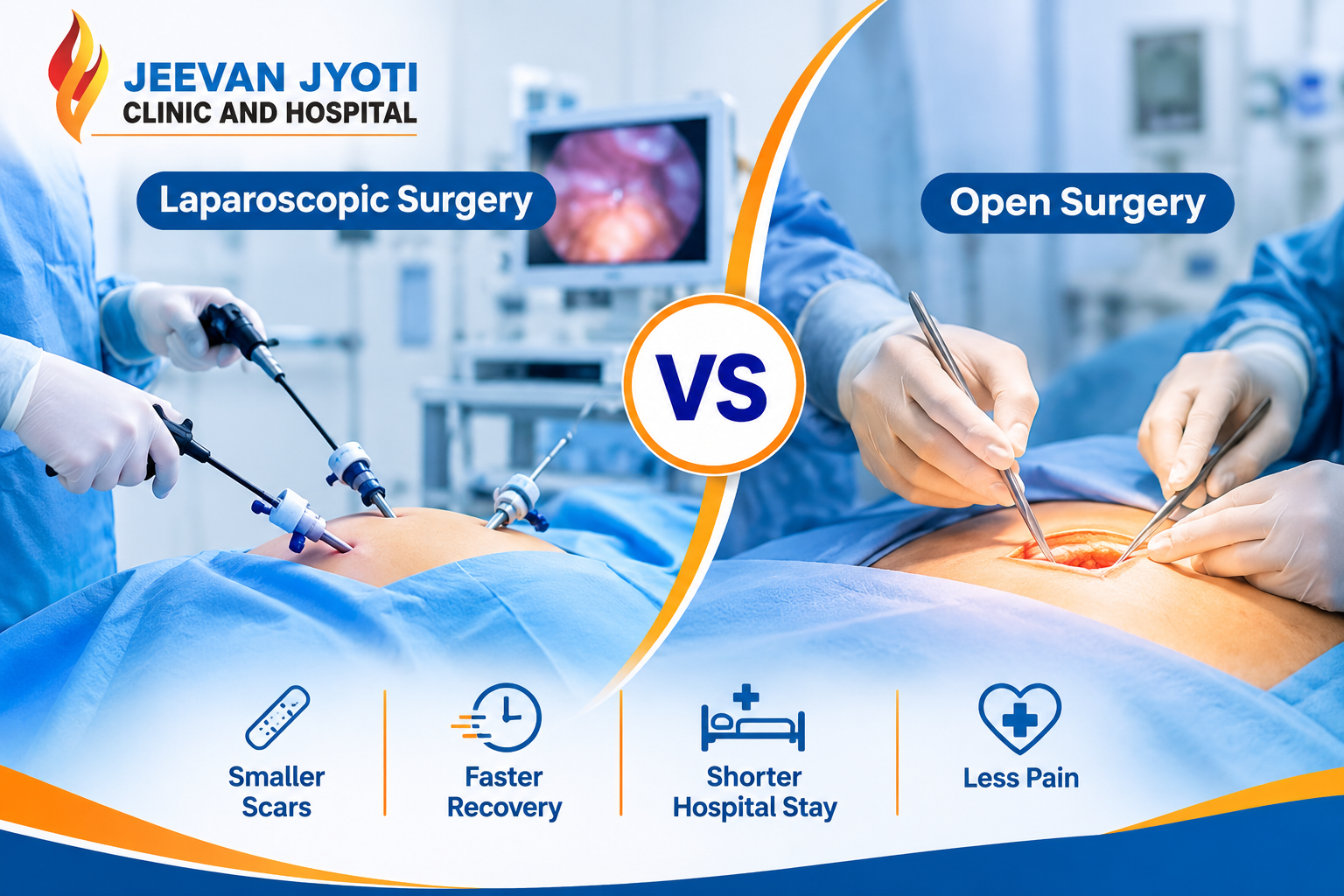
When creating a treatment plan, the type of surgery is important to consider. When patients consider treatment options, they think about different factors such as recovery time and pain, scars, risks, complications, and stay in the hospital. This information helps a patient create a dialogue with their doctor. The terms ‘laparoscopic’ and ‘open’ surgery help a patient make an informed choice about healthcare. If you are looking for the Best Laparoscopic Surgeon in East Delhi, this information is very useful.
In laparoscopic surgery, instead of a large incision, the surgeon makes several small incisions, and a camera is inserted to provide a view of the internal organs. Depending on the surgery, more specialized instruments may also be inserted.
The medical team at Jeevan Jyoti Clinic & Hospital, is committed to providing the best healthcare service and value, and helps patients make informed decisions about their healthcare.
What is Laparoscopic Surgery?
Laparoscopic surgery is a minimally invasive surgical technique that uses small incisions, a camera, and specialized instruments to perform a surgery.
The surgeon inserts the camera to provide a view of the internal organs, and the entire surgery is performed with specialized instruments. This is why it is also known as keyhole surgery.
It varies from case to case.
Common Operations Performed Using Laparoscopic Surgery
Operations such as
-Gallbladder removal (laparoscopic cholecystectomy)
-Certain appendix removals
-Some hernia repairs
-Certain gynecological surgeries
-Some diagnostic abdominal surgeries
-Certain operations on the gastrointestinal tract
Are performed using laparoscopic methods.
Not all patients and conditions benefit from this approach. The surgeon makes the final decision.
What Is Open Surgery?
This is traditional surgery where an incision is made to access the affected tissue or organ.
This technique provides for an unobstructed view of the operative site. Various complicated and advanced procedures and situations still warrant the use of this approach.
What Is The General Process Of Open Surgery?
This is generally made up of the following steps
Appropriate anesthesia is given to the patient.
An appropriate skin incision is made to reach the desired area.
The affected organ or tissue is reached.
The surgical procedure is performed.
The incision is closed using sutures, staples, etc.
The size of the incision depends on the type of the surgical procedure, the area of the patient’s body being treated, and the individual needs of the patient.
When Is Open Surgery Done?
This type of surgery is done when:
A larger surgical opening is required to treat the condition.
The affected area is not reachable with laparoscopic surgery.
The patient has complex anatomical and medical conditions.
Tissue repair and reconstruction require extensive surgery.
It is not safe to perform laparoscopic surgery.
A laparoscopic surgery is not practical in emergency cases.
Open surgery can be the best and safest method of treatment, and, in some cases, may indicate it is not an inferior method of surgery.
Laparoscopic vs. Open Surgery: Key Differences
Although both techniques aim to treat medical conditions through surgery, they differ in their approach, incision size, recovery experience, and suitability.
The following comparison explains the major differences.
| Comparison factor | Laparoscopic surgery | Open surgery |
| Incision size | Usually several small incisions | Usually one larger incision |
| Surgical view | Camera and monitor | Direct visual access |
| Scarring | Generally smaller scars | Generally a larger scar |
| Post-operative discomfort | Often less incision-related discomfort | May involve more incision-related discomfort |
| Hospital stay | Often shorter for suitable procedures | May be longer, depending on the operation |
| Recovery | Often faster for suitable procedures | May require a longer recovery period |
| Equipment | Camera and specialised instruments | Conventional surgical instruments |
| Suitability | Depends on the condition and patient | Useful for many complex and emergency procedures |
These generalizations are not absolutes. Recovery and results are based on the procedure, the patient’s health, the findings during the operation, and any problems that happen during surgery.
Advantages of Laparoscopic Surgery
Laparoscopic surgery is an important part of modern surgical techniques because it can lessen the effect surgery has on the body.
There are many advantages to a patient having laparoscopic surgery.
1. Smaller Incisions
Perhaps the most noticeable benefit of laparoscopic surgery is smaller, and sometimes less, scarring.
2. Less Pain after Surgery
Less incision-related pain is reported by patients after laparoscopic surgery compared with patients after an equivalent open surgery. Pain levels vary, and pain management is always important.
3. Less Time Spent in the Hospital
After certain surgeries, patients may be able to leave the hospital sooner after laparoscopic surgery. When a patient can be discharged from the hospital is based on many things, including pain level and control, if the patient can tolerate food and liquids, and if the patient can move about enough.
4. Return to Normal Activities Quicker
Some patients are able to go back to their normal activities faster after laparoscopic surgery. Full recovery depends on many things, including the type of surgery. Heavy lifting and strenuous activities should be done only when told to do so by the surgeon.
5. Less Scarring
Because smaller incisions are used in laparoscopic surgery, scarring is reduced. The final appearance of scarring depends on many things, including the patient’s skin and overall health, and how the patient heals and cares for the scars.
Useful in Complex Cases: Certain procedures necessitate extensive exposure that is often difficult to achieve with laparoscopic techniques.
Suitable for Certain Emergencies: Sometimes, access is required to be immediate and extensive and thus may mandate an open approach.
An Established Approach: This technique has been around a long time and in the right setting is often the best approach.
Open surgical techniques provide a larger exposure and more post-op discomfort and a longer recovery. There are often more demands on the patient post-op and they are often unable to perform physically demanding tasks for an extended period of time.
Is Laparoscopic Surgery Always Better Than Open Surgery?
No. Laparoscopic surgery is not always better than open surgery.
Some factors which influence the decision include:
1. Nature of the condition: Not all conditions can be treated in a minimally invasive fashion.
2. General health of the patient: Existing conditions, previous surgeries, and the risk factor with anaesthesia need to be taken into account.
3. Nature and extent of the procedure: Complicated and extended conditions may make an open approach more reasonable.
4. Experience of the surgeon: The surgeon’s experience with the particular approach is to be taken into consideration.
5. Safety of the patient: Ultimately, the approach which balances safety and expected benefit is to be selected.
A surgeon may elect to use the laparoscopic approach initially but convert to an open approach based on safety and the best interests of the patient. This is an accepted practice and does not necessarily mean something has gone wrong.
Evaluating Laparoscopic Surgeons in East Delhi
A surgical procedure changes your body in some way. Choosing the right surgeon is crucial when your body is on the line. It takes more than location and online reviews when considering options for the best laparoscopic surgeons in East Delhi. There are other factors that need to be evaluated.
Consider the Following Factors:
Evaluate Surgical Qualifications and Experience
The surgeon should have training in the specific surgical procedure you require and have relevant experience.
Assess the Recommended Treatment
During the consultation, there should be an explanation regarding the rationale for recommending a particular treatment, alternative treatment options, and potential risks.
Inquire About Recovery and Follow-Up
Prior to surgery, discuss what you can expect after the procedure, potential restrictions, and what you should look out for that may require medical attention.
Check Hospital Services
Ensure the hospital has the capability to provide adequate care before, during, and after the surgery, as well as diagnostic and ancillary services.
Expect Clear Communication
The surgeon and other healthcare staff should be able to explain the treatment process in a way that you can understand.
Along with the surgeon’s specialization, a patient should evaluate the hospital’s ability to provide adequate care before and after the surgery.
Smoking, Alcohol, and Medication Policy
Patients are encouraged to read and follow the specific instructions provided by their treating team.
AFTER SURGERY
General instructions after surgery include the following:
– Take medication and follow instructions for the care of the surgical wound.
– Starting as soon as you feel able, begin gentle movements.
– Drink plenty of fluids and eat nutritious foods.
– Avoid heavy lifting until your surgeon says you can.
– Go to your follow-up appointments.
– Tell your doctor if you notice your pain getting worse, if you have a fever, or if your wound is swollen, red, or draining.
– Seek immediate help if you experience chest pain, shortness of breath, fainting, or other concerning symptoms.
Frequently Asked Questions
1. Is laparoscopic surgery better than open surgery?
In most cases, laparoscopic surgery allows for smaller incisions and a quicker recovery, but open surgery may be safer and more effective for some cases. It is always surgeon and patient dependent.
2. Is laparoscopic surgery less painful than open surgery?
Many patients report less incision-related pain after laparoscopic surgery. Pain and discomfort are dependent on a person’s sensitivity, the type of procedure, and the overall process and recovery.
3. How long is the recovery after laparoscopic surgery?
Recovery time after laparoscopic surgery depends on the person and the procedure. Your doctor will give more specific instructions for your case.
4. Will laparoscopic surgery leave scars?
Yes, laparoscopic surgery leaves small scars.
5. Can laparoscopic surgery be changed to open surgery?
Laparoscopic surgery may be converted to open surgery if, during the procedure, the surgeon determines that a safety issue, unexpected findings, or difficulty in completing the surgery, exists.
6. Is open surgery practiced a lot?
Yes. Open surgery is a mainstay of treatment for many complex and emergency conditions requiring surgery.
7. Who is the best surgeon in Shahdara, East Delhi?
No single surgeon can be called the best. Select a surgeon, who after assessing all your parameters including qualifications, experience, hospital and staff facilities, and patient care after the surgery, best suits your requirements.
Conclusion
Patient education regarding open and laparoscopic surgery will help patients communicate better with their doctors regarding their options. Laparoscopic surgery allows patients to recover quicker, have smaller scars, and have less pain than open surgery. Patients that are candidates for laparoscopic surgery should strongly consider it. Open surgery should be performed on patients when a condition is complex or an emergency. The best judgment of the surgeon should be considered when determining what surgery should be done on the patient.