
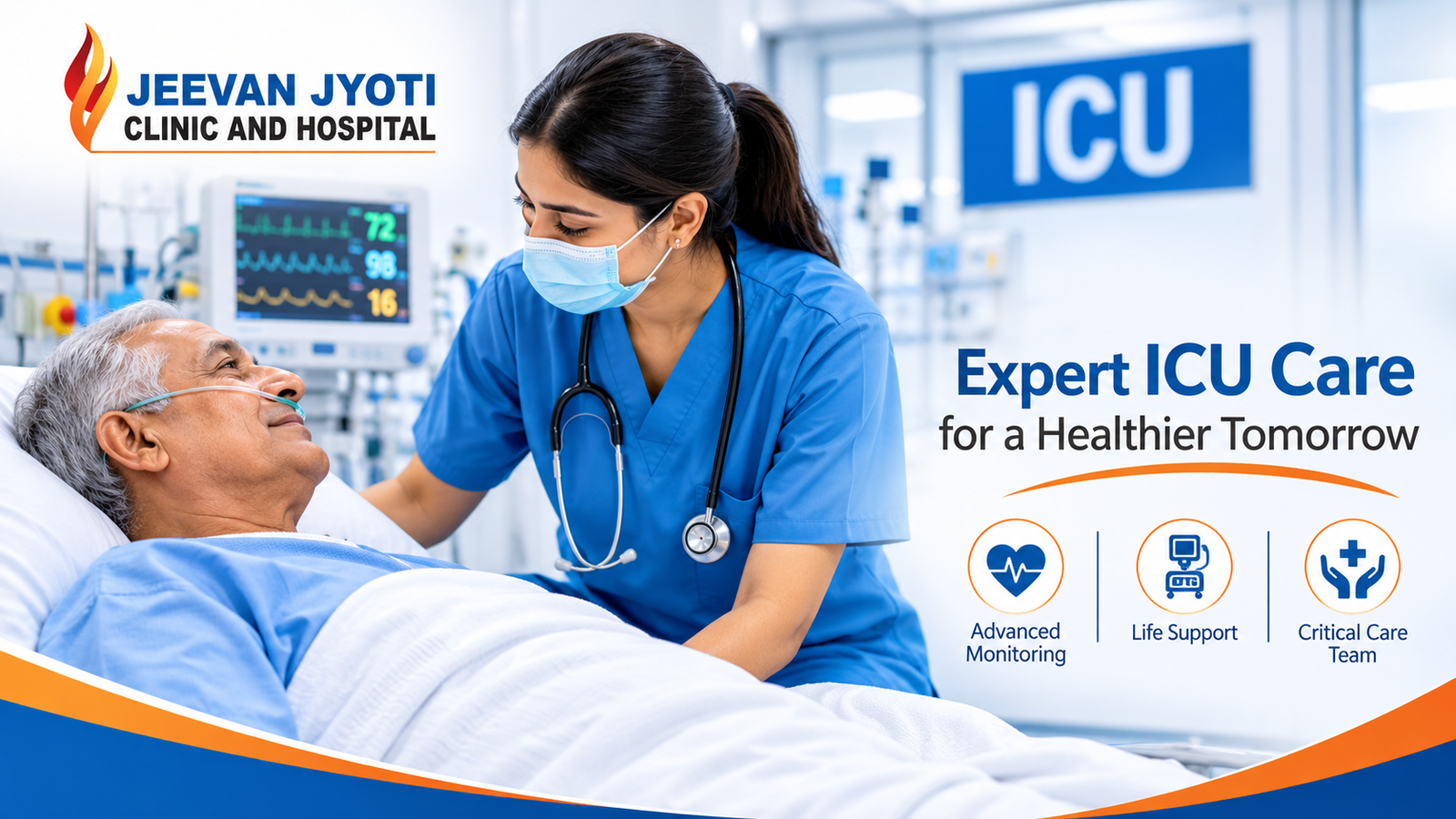
When to seek intensive care plays a role in a patient’s management. Patients in the ICU care treatment in East Delhi hospitals are managed for different types of illnesses and injuries. An ICU is for patients who require more advanced and specialized monitoring and treatment than is available on a general hospital ward. Families residing in Dilshad Garden and Shahdara areas of East Delhi, may be confused and stressed during a medical emergency. Being informed about ICU care may help them make better decisions about the care of their family members. Many types of illnesses and injuries can benefit from prompt and continued medical care. Patients who develop an infection, undergo surgery and experience complications or have an injury requiring surgery may benefit from prompt medical care and treatment.
Jeevan Jyoti Hospital strives to provide best quality health care by assessing patients’ conditions and providing appropriate treatment and interventions.
What is an ICU?
An ICU (Intensive Care Unit) is a specialized hospital unit which provides continuous specialized care to critically ill patients.
Patients on an ICU are closely monitored and supported by a group of trained healthcare professionals including:
Doctors who specialize in critical care.
ICU trained nurses.
Respiratory therapists.
Anaesthesiologists.
Other medical professionals.
Stabilizing the patient and providing care to maintain essential body functions are the basis of ICU care. Patients in the ICU have various conditions for which care and treatment are complex and require the services of an expert multi-disciplinary team. Care focuses on the following goals:
When is ICU Treatment Necessary?
Admission to an ICU may not always be necessary for a serious illness. ICU treatment is required when it is unsafe to provide the necessary treatment on a general ward. Patients who need intensive treatment and monitoring are transferred to ICU from a general ward.
Common conditions that require treatment in the ICU include the following.
1. Critical Breathing Problems
Dangerous breathing problems may occur with an infection or an attack of asthma or other lung conditions. Medical problems can cause the lungs to fail. Symptoms of respiratory failure may include the need for supplemental oxygen and difficulty in doing normal breathing. Mechanical ventilation may be necessary to support breathing.
Patients in respiratory failure will need ICU care to treat respiratory failure and to support and maintain normal breathing until the cause of the failure resolves.
A patient with a severe asthmatic attack may be successfully treated on a general ward. However if the patient’s symptoms worsen and he requires mechanical ventilation, ICU care would be necessary.
2. Problems with the Heart and Heart Attacks
Critical conditions affecting the heart may include a severe heart attack or other conditions that disrupt normal heart function. Problems with the heart may affect the heart’s ability to pump blood. Acute irregular heart rhythms may also need treatment in the ICU.
Critical low blood pressure from heart problems.
Post major cardiac event complications.
Changes in the functioning of the heart can quickly lead to more complications. Continuous telemetry allows doctors to track the heart and quickly respond to changes.
3. Severe Infections and Sepsis
In some cases an infection can result in a severe systemic response that leads to sepsis. Sepsis can quickly deteriorate an organ system and become life threatening.
Some of the most common conditions that require care in the ICU include:
1. Low blood pressure.
2. Difficulty in breathing.
3. Loss of consciousness and confusion.
4. Reduced urine output.
Sepsis can be induced by many different infections. An elderly patient with a urinary or lung infection may require care in the ICU if the infection starts to affect the function of other organ systems.
4. Major Trauma and Injuries
There are many different incidents that can result in major injuries including falls, burns and traffic accidents.
Patients may require care in the ICU if they have:
– Severe head injury requiring close observation.
– Major blood loss requiring supportive care.
– Injuries requiring emergency surgery.
– Multiple injuries requiring various forms of supportive care including assistance with breathing and blood circulation.
Patients requiring emergency treatment should be assessed and treated as quickly as possible.
5. Stroke and Other Major Neurological Problems
A stroke occurs when there is an interruption in the blood supply to part of the brain or by bleeding in the brain. Changes in the functioning of the brain can be very rapid and may require the patient to be in the ICU.
Patients exhibiting the following may also require ICU care:
Reduced consciousness.
Severe brain swelling.
Inability to swallow or protect their airway.
Severe respiratory problems.
Difficulty managing their airway after a major stroke.
Doctors assess neurological function to better understand what complications a patient may be experiencing. Complications during or after surgery may also necessitate ICU care.
6. Complications After Major Surgery
In some cases patients are observed in the ICU following major surgery, not necessarily because of an intraoperative complication.
Postoperative ICU care may be necessary in the presence of:
Respiratory failure requiring mechanical ventilation.
Cardiovascular instability.
Multi-organ system failure.
Massive blood loss.
Other postoperative complications.
Decisions regarding care are individualized based on the patient’s general health, the nature of the surgery, and the patient’s postoperative condition.
7. Kidney or Multiple Organ Failure
The kidneys are important for eliminating metabolic waste products from the body and assist with body fluid and electrolyte balance. Acute loss of kidney function can lead to accumulation of various waste products in the body which can be potentially life threatening.
Similarly, when a number of organs begin to fail simultaneously it is referred to as multiple organ dysfunction syndrome. The accumulation of many different kinds of waste products in the blood can negatively impact various organ systems.
Patients with these types of conditions may require treatment and support in the ICU to correct and manage many of these issues.
Warning Signs That May Indicate the Need for Intensive Care
Medical intervention can help if you can identify the warning signs of a condition.
Symptoms exist that require immediate evaluation by an emergency medical team, even if the patient has not been recommended for transfer to the ICU. Some of these are listed below.
If any of these are noticed, medical help should be sought immediately.
Severe shortness of breath or worsening of shortness of breath
Sudden chest pain or pressure
Losing consciousness or being unable to awaken a person
Change in behavior with confusion
Sudden weakness or paralysis of one side of the body
Rapid, severe or prolonged seizures
Prolonged or heavy bleeding that does not stop
Blood pressure that is extremely low, causing shock
Extremely rapid deterioration of a person’s condition
Some conditions require ICU care. The ICU is unfamiliar to many people and can be scary. Being aware of the processes that occur in the ICU can provide some reassurance.
The first step, in the ICU, is to do a comprehensive initial assessment of the patient to better understand the overall condition of the patient, including what symptoms the patient is having, previous treatment the patient has received, what tests have been conducted and the results of those tests. They evaluate the following vital signs:
The rate of the heart beats
The blood pressure
The level of oxygen saturation in the blood
The rate of breathing
The body temperature
The level of consciousness
2. Continuous Patient Monitoring
ICU patients’ vital signs are monitored more regularly and in greater detail than patients in general wards.
There are a variety of special monitors that assist health care workers in evaluating the status of patients in the ICU. Some are designed to alert the staff to potentially dangerous conditions that may occur in patients.
If patient conditions improve or deteriorate, the medical team adjusts the patient’s treatment plan accordingly.
3. Medication and Supportive Treatment
Depending on the patient’s condition, health care workers may administer various medications including antibiotics, medicine to lower or increase blood pressure, or pain management medications. Supportive treatment may also include administration of blood products, fluids, or oxygen.
4. Respiratory Support and Mechanical Ventilation
A patient who is unable to adequately perform the functions of respiration is supported by means of a mechanical ventilator through the use of an endotracheal tube. Non-invasive mechanical ventilation uses a mask that fits around the mouth and nose to assist a patient’s breathing. The level and type of support is determined by the physician based on the patient’s condition. Other means of respiratory support may be used in addition to or in place of mechanical ventilation.
5. Reassessment and Modification of Recovery Plan
The treatment of patients in the ICU is continuously modified and adjusted based upon the patient’s response to therapy. If the patient has improved enough to no longer need the level of support of an ICU bed, they may then be transferred to a less restricted environment. What equipment is essential in an ICU? The construction of an effective ICU requires a variety of special equipment, appropriate staff, supporting diagnostic equipment, and the ability to respond to emergency situations.
When selecting an ICU facility in East Delhi, families should be aware of the services available to them and compare them with the patient’s requirements.
Some of the important ICU facilities are:
Advanced Patient Monitoring
Equipment for monitoring a patient’s heart rate and blood pressure and oxygen saturation levels is essential for the ICU.
Mechanical Ventilators
Mechanical ventilators can be used for patient’s who are unable to perform adequate breathing. Both non-invasive and invasive ventilation may be required.
Emergency Medical Interventions
ICUs should be prepared for emergencies and have all the essential drugs readily available. Emergency requirements may arise for various reasons like cardiac or respiratory emergencies.
Diagnostic Tests
Timely investigations are essential to evaluate the patient’s condition and evaluate the efficacy of the treatment.
Dialysis
In case of certain critically ill patients, there may be an abrupt renal failure and dialysis may be required to remove excess fluid and metabolic waste from the blood.
Critical Care Team
The team consists of doctors, nurses and other health care professionals who, together, continuously assess the patient’s condition, administer treatment and take required actions.
ICU Facilities at Jeevan Jyoti Hospital, Dilshad Garden, East Delhi
Jeevan Jyoti Clinic & Hospital is a multispeciality hospital in East Delhi which caters to patients living in Dilshad Garden, Shahdara and neighboring areas of New Delhi.
The hospital has an Intensive Care Unit which provides specialized care for critically ill patients.
The hospital’s published information about their ICU states that they have:
13 ICU beds, including a 7 bed general ICU and a 6 bed Respiratory ICU.
Non-invasive and invasive ventilators to assist patients with respiratory problems.
Continuous bedside haemodialysis to assist patients with renal failure.
ABG analyzer to assess the level of oxygenation and acid-base balance.
A shortness of breath profile analyzer to evaluate respiratory problems.
A treating doctor decides upon the optimal treatment for a particular patient based upon his/her assessment of the patient’s condition and taking into consideration other complications the patient may have.
Families looking for ICU facilities in east delhi or Shahdara should first check if beds are available and verify what type of support their patient requires prior to admission.
Difference Between an Emergency Ward and an ICU
Many people assume that emergency care and intensive care are the same. However, they serve different purposes.
| Emergency Department | Intensive Care Unit |
| Provides immediate assessment and initial treatment. | Provides ongoing care for critically ill patients. |
| Treats a wide range of medical emergencies. | Treats patients who need intensive monitoring or organ support. |
| Stabilises patients and determines the next step. | Manages serious conditions requiring advanced support. |
| Patients may be discharged, admitted, or referred elsewhere. | Patients are generally admitted for continuous critical care. |
For example, someone arriving at the hospital with severe breathing difficulty may first receive emergency treatment. If the condition requires advanced respiratory support or continuous monitoring, doctors may recommend shifting the patient to the ICU.
How Long Does a Patient Need to Stay in the ICU?
There is no particular duration for an ICU stay. Patients may need ICU care for a short period of time, or a prolonged stay depending on the severity of their condition.
Factors which may influence the duration of stay in ICU include:
The medical condition of the patient.
How many organ systems are involved.
The patient’s response to treatment.
The patient’s pre-existing conditions.
Whether the patient requires mechanical ventilation or other organ support.
Finally, whether any new complications have arisen.
Various factors are considered when a patient’s stay in the ICU is determined. It depends on the medical condition of the patient and how long it takes for the patient to improve. Rarely is a patient’s stay in the ICU extended unnecessarily.
The criteria for ICU transfer is met when the patient’s condition has improved to the point where the level of care provided in the ICU is no longer needed or required.
What Should Family Members Know During ICU Treatment?
First, know that this is a difficult and emotional time for the family. Families often have many questions concerning their loved one’s condition and treatment. Talking to the medical staff caring for the patient and keeping up to date with the latest information will lessen some of the uncertainty.
It is also helpful to:
Request and insist upon regular updates about the patient’s condition and treatment.
Ask the doctor to explain the reason for and the function of any equipment the patient may be connected to.
Be sure to give the medical staff all of the information relating to the patient’s condition and treatment including pre-existing conditions, current medications, and any recent test results.
Following Hospital Guidelines
Similar to other departments of the hospital, the ICU also has procedures for visitor management and infection control. Staff will inform you about these procedures.
Discuss Recovery Plan
Find out what the medical team hopes to achieve before support is reduced and the patient is transferred to a regular ward.
Selecting The Right ICU Hospital in East Delhi
During a medical emergency it can be very difficult to find the right hospital for your family member.
While searching for an ICU hospital in East Delhi, take into consideration the following.
Check if the hospital is equipped to take care of the medical condition for which you are seeking ICU admission.
If your case requires it, check if they have a ventilator and what kind of respiratory support is available.
Enquire about the critical care doctors and nurses.
Check if the hospital has the needed diagnostic tests and emergency services.
Check if the hospital has doctors of different specialties.
Ultimately the family should be assured that the hospital has the facilities and staff to take care of their loved one.
The Right Time for ICU Care
One of the most difficult aspects of an illness to understand is figuring out when a patient’s condition has started to deteriorate.
Patients may at first appear to have a minor infection or mild breathing problem. However, such conditions may suddenly deteriorate and some patients who have undergone surgery may also develop complications requiring closer watch. Timely evaluation by a physician may help identify such risks and also assess the function of various organ systems. If an intensivist evaluates the patient and determines that the patient requires intensive care, then that patient should be admitted to the ICU.
Only a skilled intensivist can evaluate a patient and determine the level of care required, as well as the potential benefit of the intensive care.
Frequently Asked Questions (FAQs)
1. When is ICU care treatment required?
ICU care treatment is required when a patient requires treatment, monitoring and/or support for one or more of the following:
1. Breathing problems
2. Maintaining normal blood pressure
3. Support for the functioning of any vital organ of the body.
Doctors take these decisions based on the assessment of the patient’s condition.
2. Is ICU admission necessary for every serious illness?
ICU admission is not required for every serious illness. Plenty of serious illnesses can be effectively managed from an emergency room or a general ward of a hospital. ICU admission is required when a patient requires a level of monitoring or treatment which is not safely possible from a general ward.
3. What are the common reasons for ICU admission?
Common reasons include injuries, major surgical complications, breathing problems and infections.
4. What is the difference between an ICU and a general hospital ward?
Patients in a general ward are monitored and treated for stable medical conditions. Patients in an ICU are critically ill and need more advanced life support and treatment.
5. Is ICU admission always for patients with critical conditions?
No. ICU admission means that a patient needs more advanced care and support than that available on a general ward. Some patients are also admitted to the ICU for close observation, and for post-operative care, even if they do not have a life threatening condition at that moment.
6. Can a patient improve if he is ventilated?
Patients are often ventilated for a few days while they recover from a serious illness, injury or surgery. The length of stay and recovery time depend on the nature of the illness, overall health and response to treatment.
7. How long do patients typically stay in an ICU?
This also varies from patient to patient and depends on their condition.
8. What are the ICU facilities at Jeevan Jyoti Hospital, Dilshad Garden?
Jeevan Jyoti Clinic and Hospital operates a 13 bed ICU, comprising 7 bed general ICU and 6 bed Respiratory ICU. They also have ventilators and bedside haemodialysis facilities.
9. What should I bring when taking a patient to the ICU?
When time permits, bring the patient’s medical records, current prescriptions, a list of medications, allergies and medical conditions. Don’t let the lack of these documents delay transport of the patient to the ICU.
10. Are ICU facilities available for patients from Shahdara and surrounding areas?
Jeevan Jyoti Hospital is located in Dilshad Garden, East Delhi and provides health care services for patients from Shahdara and surrounding areas. Patients’ families should check with the hospital regarding the availability of required ICU facilities.
Conclusion: Get Proper Medical Intervention at the Right Moment
Several conditions such as serious illnesses, major injuries and organ failures necessitate ICU care. Being able to identify these conditions would help families take the patient to the appropriate facility in a timely manner.
Jeevan Jyoti Clinic and Hospital, Dilshad Garden, provides general and respiratory ICU facilities along with bedside dialysis and other diagnostic services for patients from Shahdara and nearby areas.
In case of an emergency, don’t hesitate to take the patient to the nearest hospital.